


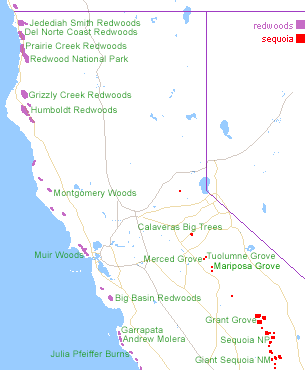
Map of California Redwood and Sequoia Groves
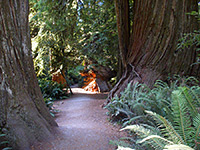
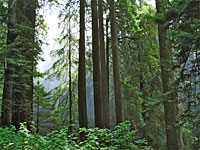
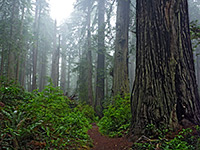
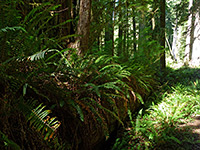
Both sequoia and redwoods have a national park dedicated to them, in addition to various smaller parks and protected areas, and even though many groves are quite similar at first sight, subtle changes in elevation, slope of the land, amount of sunlight and understory vegetation can produce noticeably different environments. Of the two, sequoia trees are perhaps most impressive, and have the thickest trunks, but redwood forests are more atmospheric, owing to much denser and more varied undergrowth, and the interplay of light and shadows created by the coastal mist.
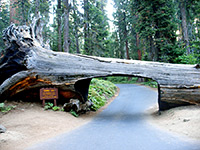
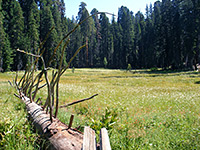
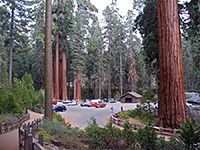
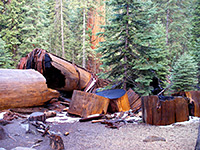
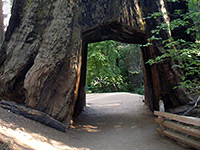
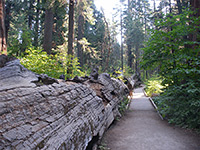
Giant sequoia (sequoiadendron giganteum) are less common than redwoods; although over 60 groves occur over a 250 mile stretch of the Sierra Nevada, most groups are rather small, some with fewer than a dozen trees, and many are rather inaccessible. The southernmost locations are in the hills west of Porterville, and 22 groves are contained within the south half of Giant Sequoia National Monument, some close to CA 190. Moving north, by far the most famous region is the 2,000 acre Giant Forest, the centerpiece of Sequoia National Park, even though the trees cover only a small section of this park; most is typical Sierra scenery of mountains and valleys.
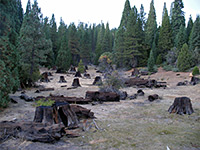
The next groups are 10 miles northwest, contained within the Grant Grove unit of Kings Canyon National Park, and the adjacent northern half of Giant Sequoia National Monument. Beyond here, the sequoia become less numerous and more isolated. There are two small groups - the McKinley and Nelder groves - in Sierra National Forest, Mariposa Grove in the south of Yosemite National Park, the Tuolumne and Merced groves further north in the park, then the north and south groves of Calaveras Big Trees State Park. The northernmost sequoia in California (a tiny group of six large trees) are deep within the Tahoe National Forest, 50 miles north of Calaveras.
- Jedediah Smith Redwoods State Park - 15 mile long stretch of particularly dark, dense and atmospheric redwood forest either side of the Smith River
- Del Norte Coast Redwoods State Park - dense, old growth redwoods along a forested ridge that slopes down very steeply to the Pacific Ocean. Includes miles of mostly inaccessible beaches
- Prairie Creek Redwoods State Park - many square miles of the densest redwood forests in the state, with 60 miles of trails
- Redwood National Park - huge area of redwood forest centered on Redwood Creek south of Orick, including Lady Bird Johnson Grove
- Grizzly Creek Redwoods State Park - two little visited groves alongside the Van Duzen River, accessed by Hwy 36
- Humboldt Redwoods State Park - largest inland groves of redwoods in California, toured by two scenic drives and many trails
- Montgomery Woods State Natural Reserve - one of the least known groves, in a remote location along the South Fork Big River
- Muir Woods National Monument - small but atmospheric and easily accessible redwood groves on the Marin Peninsula, always busy due to the proximity to San Francisco
- Big Basin Redwoods State Park - tranquil coastal redwood forests in the Santa Cruz Mountains south of San Jose; many hiking trails, some leading to very remote terrain
- Garrapata State Park - section of the northern Big Sur coastline and inland hills, including one ravine (Soberanes Canyon) containing a thin belt of redwoods
- Andrew Molera State Park - costal preserve with a few tiny redwood areas, most close to Hwy 1 as it runs one mile inland
- Julia Pfeiffer Burns State Park - popular Big Sur park that includes scattered redwood groves, viewable along two trails