

Zion Trails: Zion Canyon | Southeast | Southwest | Kolob Canyons | Kolob Reservoir Road
The Zion National Park map and Zion Canyon map indicate the location of each trail.

Zion National Park Hiking - Trails along Zion Canyon
Angels Landing Trail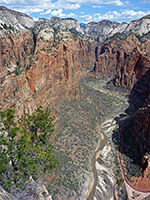 Length 2.5 miles (4 km) Elevation change 1500 feet (457 meters) Trailhead The Grotto - shuttle stop 6 Rating (1-5) ★★★★★ One of the most spectacular trails in any national park, the route to 5,785 foot Angels Landing climbs steeply up the cliffs on the west side of Zion Canyon for a panoramic view over the surrounding landscape. Most of the path is the lower end of the West Rim Trail; the Angels Landing Trail is a 0.5 mile spur to the summit. The path runs along a narrow ridge with sheer drops on either side, and chains are provided in some places to assist the ascent. |
Cable Mountain Trail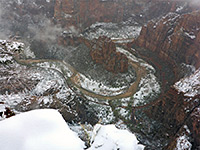 Length 2.5 miles (4 km) Elevation change 500 feet (152 meters) Trailhead Along the East Rim Trail, near Stave Spring Rating (1-5) ★★★★★ The trail to the top of Cable Mountain, a less-visited alternative to Angels Landing and Observation Point for views of Zion Canyon, begins along the East Rim Trail 4.5 miles from its western end at Weeping Rock. The path is an easy traverse of wooded, gently hilly land, ending right at the edge of the sheer cliffs above Echo Canyon and the Virgin River; site of a short-lived cable system installed in 1901. The total elevation gain if starting from Zion Canyon is 2,600 feet. |
|
Deertrap Mountain Trail Length 2.5 miles (4 km) Elevation change 500 feet (152 meters) Trailhead One mile along the Cable Mountain Trail Rating (1-5) ★★★★★ Like Cable Mountain, Deertrap Mountain is a little-visited summit on the east side of Zion Canyon, providing spectacular views over the Virgin River gorge. The summit is reached by first hiking along the East Rim Trail, starting either from the west end (4.5 miles) or the east end (5.5 miles), then a mile along the Cable Mountain Trail, then a final 2.5 miles over more wooded land to the cliff edge. The hike is normally done as a backpacking trip with one night camping along the way. |
East Mesa Trail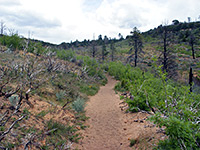 Length 4 miles (6.4 km) Elevation change 1000 feet (305 meters) Trailhead Dirt track off Chamberlain Ranch Road; also accessible from the East Rim Trail Rating (1-5) ★★★★★ The lower end of the East Mesa Trail forms part of the popular route to Observation Point and is also used to reach Mystery Canyon, a mile to the north. Beyond here the path is less used, as it bends eastwards and crosses wooded land, exiting the park and meeting a rough vehicle track that links with the Chamberlain Ranch Road. The other end is along the East Rim Trail in Echo Canyon, from where the path switchbacks up the rocky slopes to a forested mesa then is mostly level. The turn-off for Observation Point is reached after 1.5 miles. |
East Rim Trail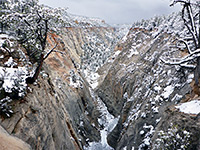 Length 10.5 miles (16.9 km) Elevation change 2600 feet (792 meters) Trailhead Parking area at the east entrance Rating (1-5) ★★★★★ The East Rim Trail is a candidate for the best hiking path in Zion National Park, passing varied scenery of high mountains, narrow canyons, forests and meadows. The east end is along UT 9 next to the east entrance station while the west end is at the Weeping Rock parking area along the scenic drive through Zion Canyon. En route are several junctions, with the Cable Mountain, Observation Point, East Mesa and Hidden Canyon trails. |
| Zion Canyon Tours |
Emerald Pools Trail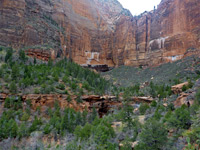 Length 1.5 miles (2.4 km) to the upper pool Elevation change 350 feet (107 meters) Trailhead Opposite Zion Lodge - shuttle stop 5 Rating (1-5) ★★★★★ Another of the more popular paths in Zion Canyon is the route to the upper, middle and lower Emerald Pools - three pretty ponds beneath sheer sandstone cliffs, formed by seasonal streams that flow from Heaps and Behunin canyons high above. Beside the pools, the trail offers nice views up and down the Virgin River Valley, and of the cliffs opposite, including Great White Throne and Red Arch Mountain. There are two separate trails to the ponds, and a third route (the Kayenta Trail) links the pools with the West Rim Trail a short distance north. |
|
Grotto Trail Length 0.5 miles (0.8 km) Elevation change level Trailhead Zion Lodge Rating (1-5) ★★★★★ Running alongside and just east of the park road, the flat Grotto Trail links Zion Lodge with the Grotto picnic area - shuttlebus stops 5 and 6. The route can be used as part of a three mile loop to the Emerald Pools (also using the Kayenta Trail), or just to experience a little of the canyon away from the highway. |
Hidden Canyon Trail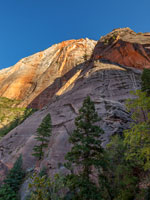 Length 1.1 miles (1.8 km) Elevation change 800 feet (244 meters) Trailhead Weeping Rock - shuttle stop 7 Rating (1-5) ★★★★★ The lower end of the cool, shady narrows of Hidden Canyon may be reached by a short though quite strenuous trail, part of which involves a traverse of a sheer cliff face with the aid of chains. Dryfalls and other confined sections can be seen by hiking and scrambling further upstream, off trail. |
Kayenta Trail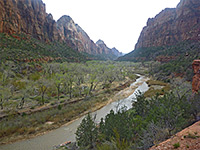 Length 1 miles (1.6 km) Elevation change 150 feet (46 meters) Trailhead Grotto picnic area Rating (1-5) ★★★★★ Starting at the Grotto picnic area, the Kayenta Trail is an alternative route to the Emerald Pools, running alongside the Virgin River for a while then turning away up a side ravine to the middle of the three main ponds. |
Observation Point Trail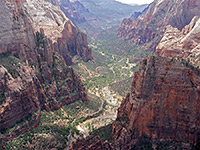 Length 4 miles (6.4 km) Elevation change 2150 feet (655 meters) Trailhead Weeping Rock - shuttle stop 7 Rating (1-5) ★★★★★ The actual Observation Point Trail is only 0.25 miles long - a spur off the East Mesa Trail - though the hike to the viewpoint is a 4 mile trip beginning at Weeping Rock on the floor of Zion Canyon. The first part of the route is the same as for Echo Canyon, followed by an steep ascent above the canyon to the plateau (on the East Mesa Trail), then the short walk west to the 6,508 foot viewpoint. This rivals Angels Landing on the opposite side of the canyon for the best views in the park. |
Pa'rus Trail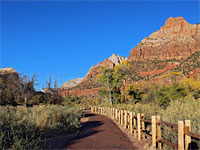 Length 1.7 miles (2.7 km) Elevation change 40 feet Trailhead Zion Canyon Visitor Center Rating (1-5) ★★★★★ The paved Pa'rus Trail (built 1995) runs alongside the Virgin River, mostly on the east side, between Zion Canyon Visitor Center and Canyon Junction. The surroundings are grassy meadows with bushes and yucca, surrounded by the high red cliffs of the canyon. Hikers share the path with cyclists, and it is also well suited for wheelchairs. |
|
Riverside Walk Trail Length 1 miles (1.6 km) Elevation change 70 feet (21 meters) Trailhead Temple of Sinawava Rating (1-5) ★★★★★ Formerly known as the Gateway to the Narrows, this shady, paved path leads northwards from the end of Zion Canyon Drive at Temple of Sinawava, following the east bank of the Virgin River to the point where the water first covers all the canyon floor - the start of the famous Zion Narrows. Many people walk a short distance further upriver though a deep section of the river after a few hundred yards tends to stop most of the casual hikers. |
Sand Bench Trail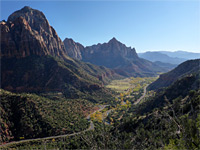 Length 4.6 miles (7.4 km) (loop) Elevation change 500 feet (152 meters) Trailhead Side road near Court of the Patriarchs Rating (1-5) ★★★★★ The Sand Bench trail loops around a partly bushy, partly open plateau beneath The Sentinel on the west side of the Virgin River, and offers impressive views of the surrounding cliffs. The trailhead is at the end of a short side road next to Birch Creek and the Court of the Patriarchs. The path is intended primarily for use by horses. |
Taylor Creek, South Fork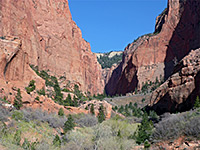 Length 1 miles (1.6 km) Elevation change 200 feet (61 meters) Trailhead Parking area along the Kolob Canyons Road Rating (1-5) ★★★★★ Path along the floor of a narrowing, riparian canyon containing much vegetation and a variety of wildlife. The upper end becomes deep and enclosed, gaining height via dryfalls and boulders |
|
Telephone Canyon Trail Length 1.8 miles (2.9 km) Elevation change 750 feet (229 meters) Trailhead Along the West Rim Trail Rating (1-5) ★★★★★ The far upper end of Telephone Canyon provides a route for a short path that begins and ends at junctions with the West Rim Trail, cutting about a mile off that route though encountering less spectacular scenery - the valley is wooded and distant views are limited. |
Watchman Trail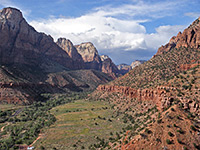 Length 1.4 miles (2.3 km) Elevation change 450 feet (137 meters) Trailhead Near the visitor center Rating (1-5) ★★★★★ From the Zion Canyon Visitor Center near Watchman Campground, this path climbs into a small ravine then bends back westwards to a promontory overlooking the Virgin River valley. There is no shade along the path so it can be hot in summer. The viewpoint has excellent views over nearby peaks including Bridge Mountain, the West Temple and the distinctive spire of the Watchman. |
Weeping Rock Trail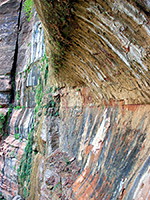 Length 0.25 miles (0.4 km) Elevation change 60 feet (18 meters) Trailhead Weeping Rock - shuttle stop 6 Rating (1-5) ★★★★★ Weeping Rock is one of Zion's most photographed places - a curved cliff face that continually seeps water at the junction of two sandstone strata (the Kayenta and Navajo layers), sustaining a curtain of ferns, moss and wildflowers. The short, paved path to the rock begins beside the Zion Canyon Drive, at the same trailhead for Hidden Canyon, Observation Point, Echo Canyon and the East Rim. It ascends gently to a viewpoint at the base of the cliff. |
Zion Narrows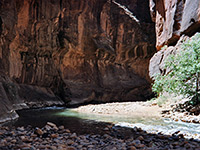 Length 15.6 miles (25.1 km) for the whole canyon Elevation change 1200 feet (366 meters) Trailhead Near Chamberlain Ranch, 17.4 miles from UT 9; also accessible from the lower end Rating (1-5) ★★★★★ The most famous narrow canyon hike in the Southwest, following the North Fork of the Virgin River past near vertical walls up to 2,000 feet high. Generally passable only during late summer and fall, as the water is too deep and fast flowing at other times. The full canyon is best explored from the top (perhaps with one night camping en route), but most people start at the lower end and hike just a short distance upstream. |
Zion National Park Hiking - Trails in the Southeast
Canyon Overlook Trail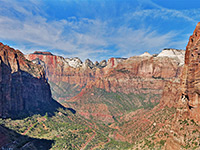 Length 0.5 miles (0.8 km) Elevation change 160 feet (49 meters) Trailhead Pullout along UT 9, near the east end of the tunnel Rating (1-5) ★★★★★ This easy, popular path - the only official trail in the southeast section of Zion NP, along UT 9 - offers hikers a grand view down the deep valley of Pine Creek, which joins the Virgin River near the lower end of Zion Canyon. The route is through interesting, rocky scenery, past the upper end of the Pine Creek slot canyon. |
Zion National Park Hiking - Trails in the Southwest
Chinle Trail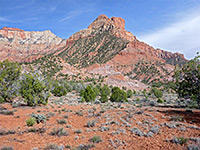 Length 8 miles (12.9 km) to Coalpits Wash Elevation change 650 feet (198 meters) Trailhead Along Anasazi Way, just off Hwy 9 Rating (1-5) ★★★★★ The Chinle Trail is named after the predominant rock layer found along the way - the colorful Chinle Formation, and is also known as the Petrified Wood Trail on account of the small pieces of fossilized logs that may be found. The little used path crosses the low elevation southwest corner of Zion National Park, still in sight of high red and white cliffs to the north though passing across open, flattish land with bushes, cacti and yucca. The start point is along UT 9 south of Springdale, and the path ends besides Coalpits Wash, though continuation hikes up or down the wash are possible, or along two other drainages crossed en route. |
Coalpits Wash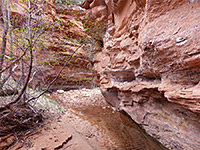 Length 8 miles (12.9 km) to the upper end of the narrows Elevation change 1000 feet (305 meters) Trailhead Along Hwy 9, 2 miles west of Rockville Rating (1-5) ★★★★★ Lengthy drainage in the low elevation southwest corner of the park, containing long sections of shallow, flowing water; followed by a trail that is initially quite well used, but fades away in the upper section, where the stream forms some pools, cascades and narrow channels. |
Eagle Crags and Lower Mountain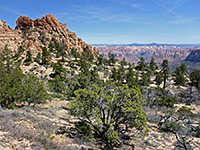 Length 5 miles (8 km) to the plateau rim Elevation change 1800 feet (549 meters) Trailhead Along an unpaved road southeast of Rockville Rating (1-5) ★★★★★ The Eagle Crags are a group of sandstone pinnacles at the end of a ridge on the south side of the Virgin River, reached by a semi-maintained trail, ending at an impressive viewpoint. A much rougher route continues to the rim of Lower Mountain, an isolated plateau covered by eroded formations. |
Zion National Park Hiking - Trails in the Kolob Canyons District
|
Hop Valley Trail Length 7 miles (11.3 km) Elevation change 1000 feet (305 meters) Trailhead Along Kolob Reservoir Road Rating (1-5) ★★★★★ The Hop Valley Trail connects the Kolob Reservoir Road with the La Verkin Trail and hence the Kolob Canyons Road, running through an open, sandy valley with good views of the Kolob Canyons though the immediate surroundings are not that interesting. |
Kolob Arch Trail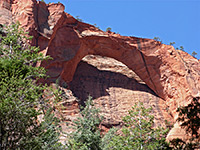 Length 0.6 miles (1 km) Elevation change 150 feet (46 meters) Trailhead Along the La Verkin Creek Trail Rating (1-5) ★★★★★ The short spur path to Kolob Arch begins along the La Verkin Creek Trail - a short walk up a tributary of the creek to a viewpoint beneath the arch, which is one of the largest in the world with a span of 287 feet. The arch is 6.5 miles from the Lee Pass trailhead on the Kolob Canyons road, so can be reached on a day hike. |
La Verkin Creek Trail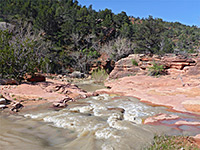 Length 11.5 miles (18.5 km) Elevation change 1200 feet (366 meters) Trailhead Lee Pass Rating (1-5) ★★★★★ This lengthy backcountry route begins at Lee Pass, about half way along the paved Kolob Canyons Road. It follows the wooded valley of Timber Creek southwards, beneath the towering cliffs that characterize this section of the park, then turns east along the larger drainage of La Verkin Creek. 6.5 miles from the start is the turn-off for the short path to Kolob Arch, then soon after is another junction, with the Hop Valley Trail. The main path, now less used, continues eastwards through a narrowing, overgrown canyon, then up the tributary gorge of Willis Creek as far as the park boundary. Although a trail goes on and eventually meets the Kolob Reservoir, it crosses private land to which access is currently closed. |
Taylor Creek, Middle Fork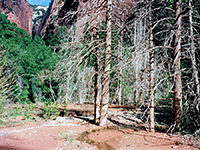 Length 3.1 miles (5 km) to where the canyon becomes steep and narrow Elevation change 700 feet (213 meters) Trailhead Along the paved Kolob Canyons Road Rating (1-5) ★★★★★ Most enclosed of the Finger Canyons of the Kolob; a narrowing, vegetation-filled valley containing a small stream, eventually becoming sheer sided, though gaining height steeply via boulders and falls. Also contains Double Arch Alcove, a colorful eroded cavity. |
Zion National Park Hiking - Trails along the Kolob Reservoir Road
North Creek, Left Fork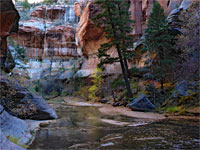 Length 3.4 miles (5.5 km) to the Subway Elevation change 1200 feet (366 meters) Trailhead Parking area along Kolob Reservoir Road Rating (1-5) ★★★★★ Popular, oft-visited narrow canyon that includes The Subway, where the creek flows through a long, tubular passage with only a narrow opening above. Further upstream are deep pools and drop-offs that may be seen (with use of ropes) if starting from an alternative trailhead, but most just explore the lower narrows. |
North Creek, Right Fork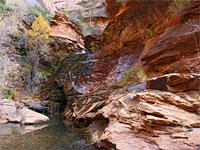 Length 5.8 miles (9.3 km) Elevation change 900 feet (274 meters) Trailhead 7 miles north of Hwy 9 along Kolob Reservoir Road Rating (1-5) ★★★★★ Lower portion of a lengthy drainage that narrows gradually to a deep, enclosed section with many waterfalls, pools and boulders, to the larger Barrier Falls, which is impassable from below |
Northgate Peaks Trail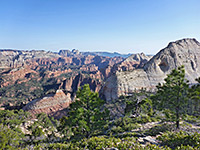 Length 2 miles (3.2 km) to the promontory Elevation change 100 feet (30 meters) Trailhead Wildcat Canyon trailhead, along Kolob Reservoir Road Rating (1-5) ★★★★★ The Northgate Peaks are a pair of rounded, smooth-sided summits at the edge of Pine Valley, along the Kolob Reservoir Road. An easy trail crosses the forested valley to a viewpoint between the peaks of cliffs and canyons to the south, including the Left Fork of North Creek. The summits can be climbed, for even better views; the easternmost is easier. |
West Rim Trail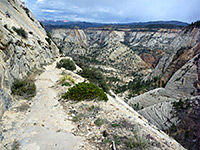 Length 14.5 miles (23.3 km) Elevation change 3600 feet (1097 meters) Trailhead Dirt road east of Lava Point; also accessed from Zion Canyon Rating (1-5) ★★★★★ The longest trail in Zion National Park, this begins in the high country along the Kolob Reservoir Road, beneath 7,890 foot Lava Point. The first few miles are across the fairly level land of Horse Pasture Plateau, through sparse pine forest then more bushy, open ground as the path gradually descends. The views become more spectacular as the trail approaches the rim of the high cliffs above Phantom Valley in the west, which is followed for 2 miles, until a steep descent to a saddle between the upper ends of Behunin and Telephone canyons. The final section is down into Telephone Canyon, on to Refrigerator Canyon, where it passes the spur path to Angels Landing, then to Zion Canyon near the Grotto picnic area. |
|
Wildcat Canyon Trail Length 6 miles (9.7 km) Elevation change 1000 feet (305 meters) Trailhead Short spur off Kolob Reservoir Road Rating (1-5) ★★★★★ The Wildcat Canyon Trail links Lava Point with the Kolob Reservoir Road in Pine Valley, so providing an alternative to the road for backpackers crossing the north section of the park. It is also used to reach upper Wildcat Canyon and Russell Gulch, the start of the canyoneering route down North Creek. |
All Contents © Copyright The American Southwest | Comments and Questions | Contribute | Affiliate Marketing Disclosure | Site Map