

Introduction to Slot Canyons
Few places on Earth have such beauty and mystique on an intimate scale as the delicately scupltured and colored slot canyons of the American Southwest. There are thousands of scenic canyons in this region but most are relatively wide and often descend in steps through rock layers of differing hardness; in contrast, slot canyons have vertical walls and may be hundreds of feet deep but only a few feet wide.
The general rock is sandstone, in various shades of red and orange; it is sunlight, shining down and reflecting along the canyon walls that gives the canyons their special beauty; the shadows and colors change constantly as the sun moves overhead.
Most slot canyons are remote, hidden and difficult to reach and explore, but this only adds to their appeal; one can get a good idea from a photograph, but this is no substitute for visiting in person. The canyons tend to be dry for most of the year but receive occasional flash floods of great force, most frequently during the late summer months. It is these sudden torrents of water, carrying logs, stones and other debris that have been cutting through the relatively soft rock for millions of years, resulting in a great variety of colorful rock shapes and forms.
The general rock is sandstone, in various shades of red and orange; it is sunlight, shining down and reflecting along the canyon walls that gives the canyons their special beauty; the shadows and colors change constantly as the sun moves overhead.
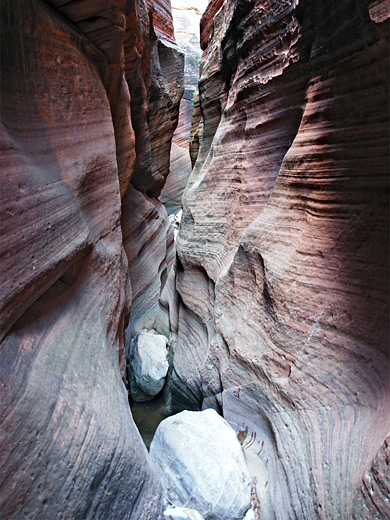
Most slot canyons are remote, hidden and difficult to reach and explore, but this only adds to their appeal; one can get a good idea from a photograph, but this is no substitute for visiting in person. The canyons tend to be dry for most of the year but receive occasional flash floods of great force, most frequently during the late summer months. It is these sudden torrents of water, carrying logs, stones and other debris that have been cutting through the relatively soft rock for millions of years, resulting in a great variety of colorful rock shapes and forms.
In general, true slot canyons are found only on the many rivers and their tributaries that ultimately flow into Lake Powell, in Utah. There are three main drainage systems; various creeks that cross Navajo land south of the lake in Arizona, branches of the Paria River to the west, and branches of the Escalante and other rivers to the north.
Most of these canyons are in the same rock layer; red Navajo sandstone, which seems to be particularly suited to the formation of slot canyons. A slightly different type of narrow canyon is found in the Kolob Plateau in and around Zion National Park, formed by tributaries of the Virgin River; these are a little wider and less winding but much deeper and often have water flowing through all or most of the year.
The plateau is also made predominantly of Navajo sandstone, which here ranges in color from red to white. The canyons often have wonderful pools, waterfalls and narrow channels, which make them even more fascinating to explore.
Most of these canyons are in the same rock layer; red Navajo sandstone, which seems to be particularly suited to the formation of slot canyons. A slightly different type of narrow canyon is found in the Kolob Plateau in and around Zion National Park, formed by tributaries of the Virgin River; these are a little wider and less winding but much deeper and often have water flowing through all or most of the year.
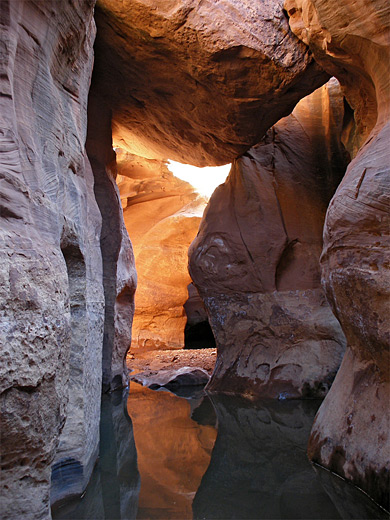
The plateau is also made predominantly of Navajo sandstone, which here ranges in color from red to white. The canyons often have wonderful pools, waterfalls and narrow channels, which make them even more fascinating to explore.
All Contents © Copyright The American Southwest | Comments and Questions | Contribute | Affiliate Marketing Disclosure | Site Map