

Highlights:
Small cave system quite high up the south side of American Fork Canyon, near Mount Timpanogos in the central Wasatch Range - reached by a steep, 1.5 mile trail and viewable only via a ranger-led tour
Nearby town:
American Fork, 8 miles
Management:
Location:
Seasons:
May to November - closed during winter because of snow
Rating (1-5):
★★★★★

Featured Hotel
Holiday Inn Express American Fork
 Along I-15 in American Fork, close to several restaurants, and a short drive from Timpanogos Cave. Free hot breakfast and an indoor pool
Check Rates
Covering an area of less than one square mile, Timpanogos Cave National Monument protects three interlinked limestone caverns, 1,090 feet above the floor of American Fork Canyon near Mount Timpanogos in the Wasatch Mountains, reached by a steep 1.5 mile trail up the rocky slopes. The hike is quite strenuous, so relatively few make the journey yet even so, in summer a wait of several hours may be necessary before entering the caves, which may only be visited as part of a ranger-led guided tour.
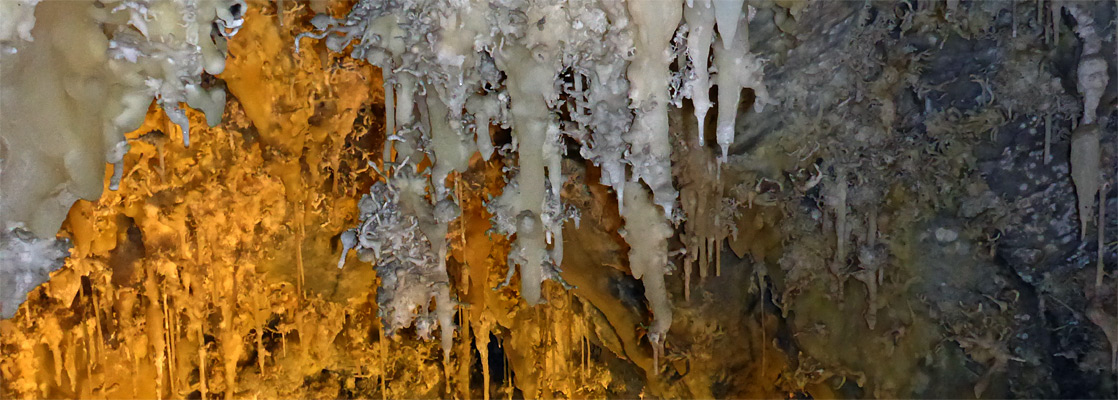
The formations are on a much smaller scale than in other more famous cave systems such as Carlsbad Caverns in New Mexico but are still very pretty, the main attraction here being the multitude of helicites - an unusual, twisting, microcrystalline variety of calcite that adopts many delicate forms.
The formations are on a much smaller scale than in other more famous cave systems such as Carlsbad Caverns in New Mexico but are still very pretty, the main attraction here being the multitude of helicites - an unusual, twisting, microcrystalline variety of calcite that adopts many delicate forms.
Timpanogos Cave Table of Contents
Trail to the Caves
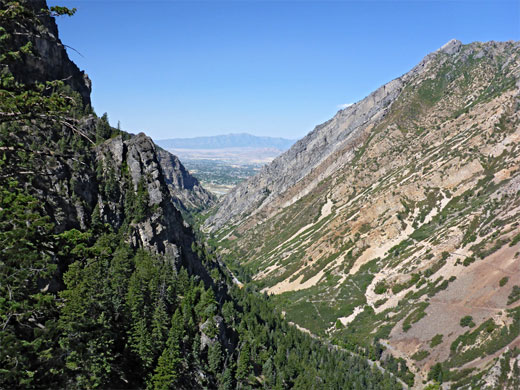
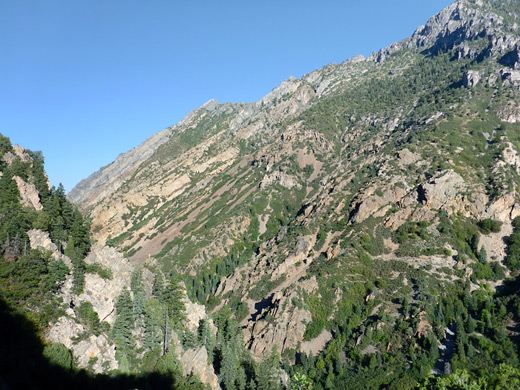
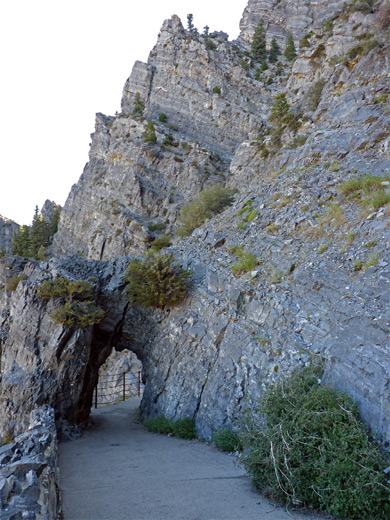
Timpanogos Cave National Monument also contains two picnic areas on the banks of American Fork Creek, a short nature trail and a visitor center from where tickets for the cave tours are purchased. 2024 prices are $12 per adult, $7 per child aged 2-11 and $2 for those aged under 2. The tours accommodate a maximum of 16 people per group and take about 50 minutes. As waiting space at the cave entrance is limited, visitors are given a suggested time to start the hike; on some popular days, all places may be taken by early afternoon and advance reservations are recommended. The usual time for hiking the paved, 1.5 mile trail is given as 1.5 hours but it can be done in around 40 minutes. The path is consistently steep from the beginning, climbing up the crumbing igneous rocks of the canyon - composed mainly of quartzite and dolomite; rock falls are common, especially in winter, and as a consequence stopping is not allowed on some parts of the trail deemed to be most at risk. There are several numbered points of interest along the route, mostly rocks and plants, while signs also mark progress up the hillside, at quarterly intervals, and warn against various dangers including rattlesnakes and falling rocks. The path offers grand views of American Fork Canyon, especially to the southwest, towards Provo and the desert flats beyond. Conditions are especially atmospheric in early fall, as the trees begin to display their bright red and orange colors, and the tops of the mountains are often hidden by low cloud. Deteriorating weather closes the trail and the caves from late October to May.
History of Timpanogos Cave
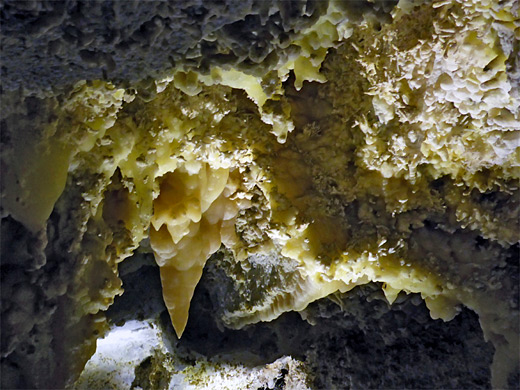
The trail ends at a covered waiting area, elevation 6,730 feet, in front of the entrance to the first cave, beside a semi-enclosed passageway containing few exhibits and notices. The three caverns were discovered at different times and were originally separate; they have since been linked by short tunnels. The earliest to be explored, and first entered today, was Hansen Cave in 1887; this joins Middle Cave, discovered in late 1921 by the family of Jim Hansen who found the original cave. Timpanogos Cave is the third, the largest and the most spectacular; this was found in 1914 but its location became forgotten until being rediscovered in summer 1921. The national monument was proclaimed in 1922, and about 60% of the 2 miles of underground passages are visited on the guided tour. The caves are relatively new - they were formed along fractures in the limestone around 200,000 years ago and are still actively changing, as water - principally from the spring snowmelt - continually seeps into the passages depositing more minerals and creating new crystalline formations. Most of Hansen Cave is not visited on the regular route but can be seen on the 1.5 hour, more strenuous Introduction to Caving Tour, which has a limit of five people.
Inside the Caves
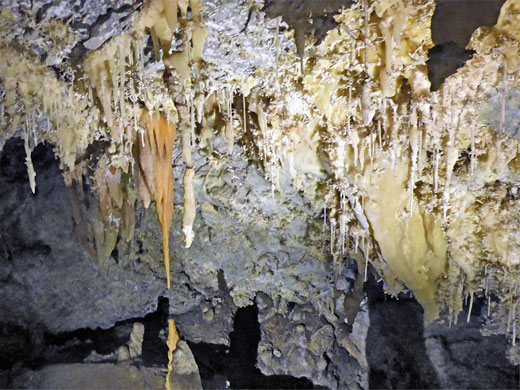
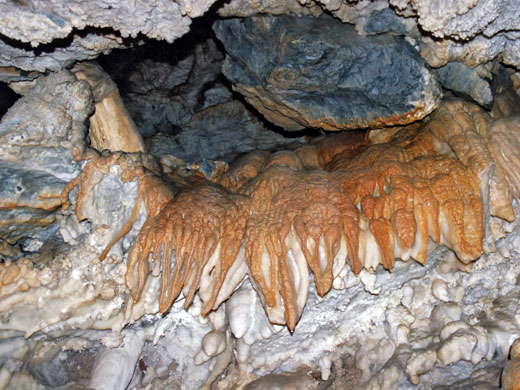
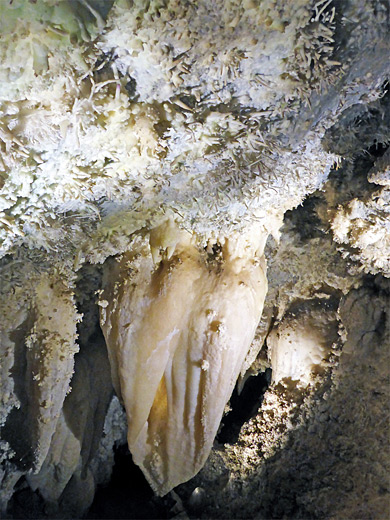
Inside, the passageways are mostly quite narrow but open out to a few large chambers; all are subtly, rather dimly illuminated by lamps operated by timer switches, so as not to damage the formations by constant light; as a result, photography is quite difficult and long exposures are needed. The temperature in all the caves is around 45°F. The constructed tunnels have doors to prevent draughts and maintain a high moisture level, since water is a vital part of the ecosystem, dripping from above creating new speleothems and collecting in numerous pools. Helicites form by capillary action and are unusual because they are unaffected by gravity, growing randomly in all directions. Mostly pure white, some have yellowish tints caused by nickel impurities. Other features are the usual stalagmites and stalactites, plus draperies and flowstones - large scale rippled deposits that resemble solidified waterfalls or cascades of rock. Wildlife underground is quite limited, generally just bats, crickets and spiders; the pack rats that once occupied the caves have disappeared since the entrances were sealed. The caves are exited via an artificial tunnel that emerges a few hundred feet east of the entrance.
Timpanogos Cave Wildflowers
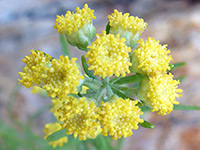
Photographs and descriptions of flowering plants found in the national monument
Timpanogos Cave - Nearby Places
- Nebo Loop Scenic Byway (35 miles) - narrow, winding road through the southern end of the Wasatch Range
- Wasatch Mountain State Park (30 miles) - wooded hills at the east side of the Wasatch Range
Timpanogos Cave - Similar Places
- Carlsbad Caverns, New Mexico - the most famous cave system in the world
- Lehman Caves, Nevada - another cavern system with beautiful limestone formations
All Contents © Copyright The American Southwest | Comments and Questions | Contribute | Affiliate Marketing Disclosure | Site Map