

The Dinosaur Quarry, Dinosaur National Monument
Utah > Dinosaur National Monument > The Dinosaur Quarry
Highlights:
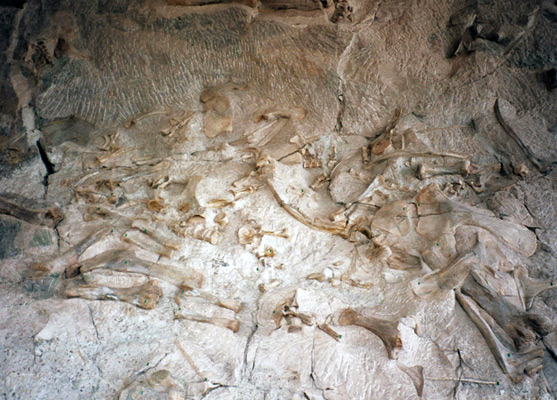
The main fossil location in Dinosaur National Monument; an angled, excavated cliff face displaying hundreds of bones, contained within a recently rebuilt, glass-walled building
Location:
40.440, -109.301 (quarry building)

The quarry building, where around 1,500 dinosaur bones may be viewed in situ, was closed in July 2006 due to subsidence caused by movement of unstable soil beneath, but after lengthy reconstruction was finally reopened October 2011. Now known as the Quarry Exhibit Hall, the glass-walled structure sits on a small hill a quarter of a mile from the vistitor center, and is accessible only by shuttlebus during the busy summer season; at other times visitors may drive there. Dinosaur bones can also be seen nearby along the 1.4 mile Fossil Discovery Trail - see hiking guide.
Dinosaur Quarry Table of Contents
Geology
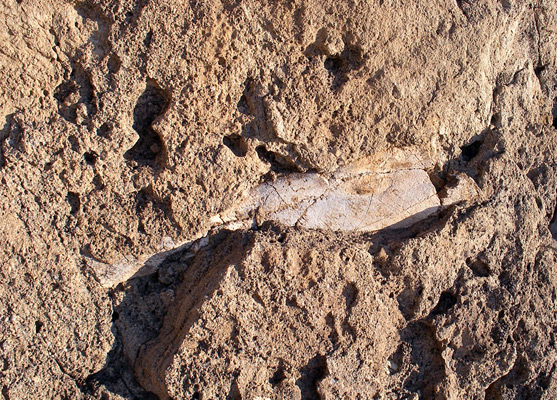
Fossilized bones have been found in many locations in the hills of the national monument, but by far the most spectacular discovery was made by paleontologist Earl Douglass in 1909, who found 8 segments of the tail of a Brontosaurus at the top of a steep sandstone cliff. Many years of excavation revealed a huge number of bones including some complete skeletons of creatures such as the small Camptosaurus and the plated Stegosaurus, most of which now reside in the Carnegie Institute in Pittsburgh. The longest ever recorded dinosaur skeleton was found here; the bones of a Diplodocus were assembled from parts of 3 separate incomplete individuals to give a skeleton nearly 27 meters long. It is now established that 150 million years ago, this area was part of a riverbed, where a sand bank caused a large number of dead animals washed downstream during flooding to collect in one place. These were then covered by a great thickness of sediment and fossilized. Much later, uplift, bucking and erosion of the surrounding rocks exposed the bones, now part of a cliff angled at 67° off the horizontal.
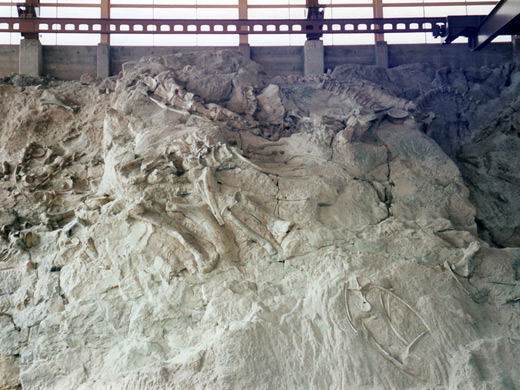
The Dinosaur Quarry Building
One section of the cliff about 15 meters wide and 10 meters high was not fully excavated - instead the bones were uncovered but left in situ. A large glass-walled building, considered futuristic at the time of its construction, was built to protect the bones and allow visitors to view them. The slow process of exposing more of the fossils still continues and during the summer, the on-going work and research of the paleontologists can be observed. The (original) award-winning building was built in 1957, while the 2011 replacement, well as the cliff face, houses a gift shop, a research laboratory and a small but very interesting museum. This has much information about the methods and tools of the early prospectors, various large bones, and replicas of some of the complete skeletons that were found in the quarry. The cliff face can be viewed from two levels, allowing visitors a close look at the many different bones - mainly sections of backbone and limbs but also two skulls, although these are harder to spot as they are flattened and distorted.
All Contents © Copyright The American Southwest | Comments and Questions | Contribute | Affiliate Marketing Disclosure | Site Map